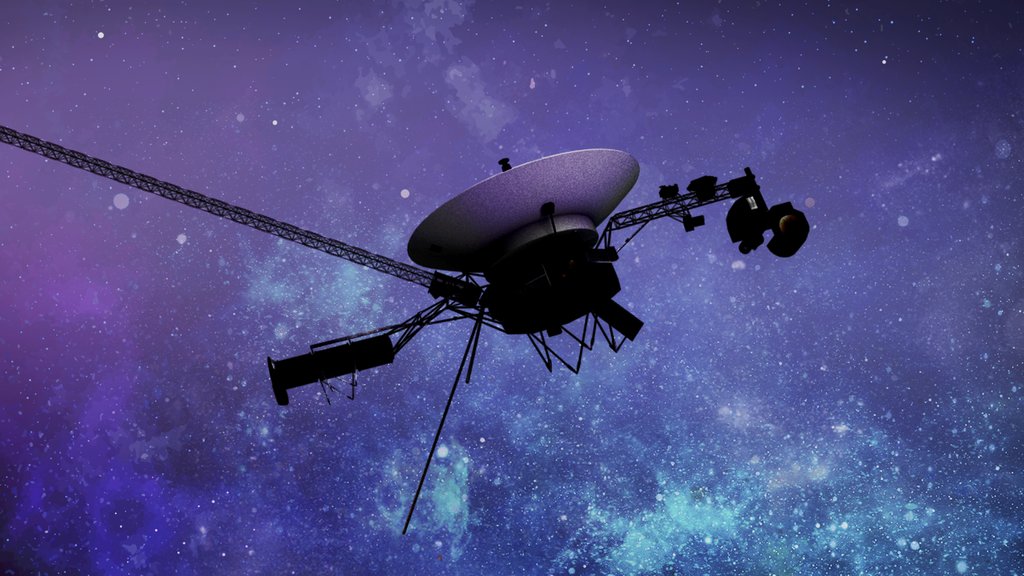
Launched in 1977, NASA’s Voyager 1 and Voyager 2 spacecraft have been on an extraordinary journey, venturing beyond our solar system into interstellar space. Designed for a five-year mission to study the outer planets, these probes have far exceeded expectations, operating for over 47 years. However, as their power sources diminish, NASA has begun deactivating certain instruments to extend their operational lifespans.
Power Constraints and Instrument Deactivations
Both Voyager spacecraft are powered by radioisotope thermoelectric generators (RTGs), which convert heat from decaying plutonium-238 into electricity. These RTGs lose approximately 4 watts of power annually, necessitating strategic shutdowns of onboard instruments to conserve energy.
- Voyager 1: On February 25, 2025, NASA engineers deactivated the Cosmic Ray Subsystem (CRS) experiment. This suite of three telescopes was designed to study cosmic rays, including protons from the galaxy and the Sun, by measuring their energy and flux. Data from these telescopes helped determine when and where Voyager 1 exited the heliosphere. NASA Jet Propulsion Laboratory
- Voyager 2: Scheduled for March 24, 2025, the Low-Energy Charged Particle (LECP) instrument will be turned off. This instrument measures various ions, electrons, and cosmic rays originating from our solar system and galaxy. It consists of two subsystems: the Low-Energy Particle Telescope for broader energy measurements and the Low-Energy Magnetospheric Particle Analyzer for more focused magnetospheric studies. Both systems use a rotating platform powered by a stepper motor that has far exceeded its expected operational lifespan. NASA Jet Propulsion Laboratory
With these shutdowns, each spacecraft will have three of their original ten instruments still functioning. These measures are expected to prolong the missions for about another year.
Scientific Contributions and Legacy
The Voyager probes have vastly exceeded their initial mission objectives. Voyager 1 discovered a thin ring around Jupiter and some of Saturn’s moons, while Voyager 2 is the only spacecraft to have visited Uranus and Neptune. Both spacecraft have provided invaluable data about the heliosphere—a protective bubble of solar wind and magnetic fields created by the Sun—and interstellar space. Voyager 1 reached interstellar space in 2012, followed by Voyager 2 in 2018.
NASA Jet Propulsion Laboratory
Future Prospects
NASA engineers anticipate that with continued power management, the Voyagers could operate with at least one science instrument into the 2030s. However, given their age and the harsh environment of space, unforeseen challenges could arise. Despite these uncertainties, every additional day the Voyagers operate offers a chance for new interstellar discoveries.
NASA Jet Propulsion Laboratory
The enduring legacy of the Voyager missions underscores the remarkable achievements of human ingenuity and the relentless pursuit of knowledge beyond our solar system.
NASA’s Voyager Probes Face Instrument Shutdowns to Conserve Power



Leave a comment