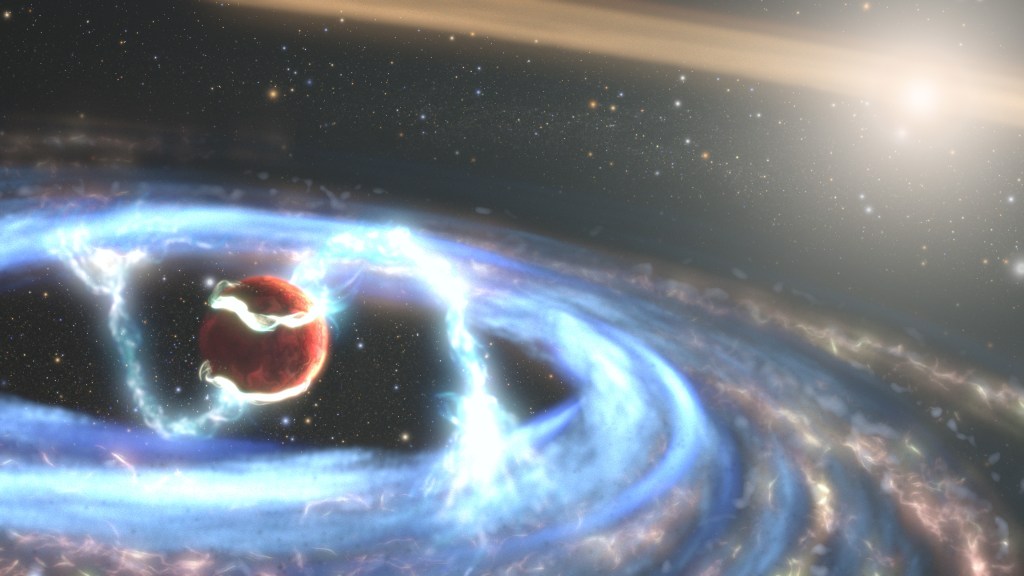
Parent Star: PDS 70

- Stellar Classification: T Tauri-type Young Star
- Age: Approximately 5.4 million years
- Mass: 0.76 ± 0.05 solar masses
- Spectral Type: K7-M0
- Location: Centaurus Constellation
- Distance from Earth: 370 light-years
Planetary System Architecture
The PDS 70 system represents a critical astronomical laboratory, featuring:
- A young protoplanetary disk
- Multiple planetary embryos
- Active planetary formation processes
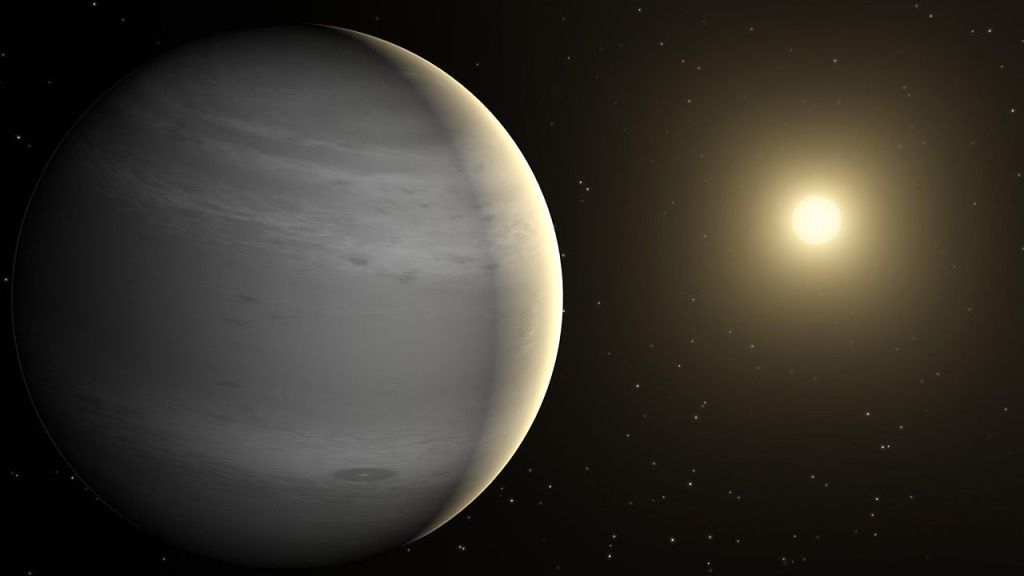
Detailed Planetary Characteristics of PDS 70b

Fundamental Physical Parameters
- Mass: 4.2 ± 0.5 Jupiter masses
- Radius: 2.1 ± 0.3 Jupiter radii
- Surface Temperature: 1,200-1,400 Kelvin
- Orbital Period: Approximately 118 Earth years
- Orbital Distance: 22 astronomical units
- Orbital Eccentricity: 0.38 ± 0.05
Planetary Interior Structure
Core Composition
- Core Mass: Estimated 10-15 Earth masses
- Composition: Mixture of rocky materials, metallic elements
- Core Temperature: Approximately 15,000-20,000 Kelvin
- Core Pressure: Estimated 3-4 million atmospheres
Layered Internal Structure
- Metallic Core: Dense, high-pressure region
- Rocky Mantle: Intermediate transition zone
- Gaseous Envelope: Hydrogen-helium dominated outer layers
- Potential Water Layer: Significant hydrogen-oxygen compounds
Atmospheric Composition
Primary Atmospheric Components

- Hydrogen (H₂): 89-92%
- Helium (He): 7-9%
- Methane (CH₄): 0.5-1.2%
- Water Vapor (H₂O): Significant traces
- Trace Elements: Ammonia, carbon monoxide
Atmospheric Characteristics
- Average Pressure: 100-150 bar at reference level
- Wind Speeds: Potentially 300-500 m/s
- Cloud Formations: Silicate and metallic vapor clouds
- Temperature Gradient: Decreasing with altitude
Water Composition and Distribution
Hydrological Characteristics
- Total Water Equivalent: Estimated 3-5 times Earth’s total water volume
- Water Distribution:
- Atmospheric water vapor
- Potential liquid water zones
- Water ice in deeper layers
- Hydrogen-Oxygen Ratio: Enhanced compared to solar system standards
Planetary Formation Dynamics
Formation Timeline
- Initial Disk Accretion: 5.6 million years ago
- Core Formation: Approximately 4-5 million years ago
- Ongoing Planetary Migration: Currently in progress
Formation Mechanisms
- Core Accretion Model: Primary formation hypothesis
- Direct Disk Instability: Potential secondary mechanism
- Gravitational Interactions: Continuous planetary system reshaping
Observational Methodologies

Detection Techniques
- Direct Imaging: European Southern Observatory VLT
- Adaptive Optics: Advanced infrared observations
- Spectroscopic Analysis: Detailed compositional mapping
Instrumental Technologies
- ALMA Telescope: Millimeter-wave observations
- Hubble Space Telescope: Complementary imaging
- Very Large Telescope (VLT): Primary detection instrument
- James Webb Space Telescope: Future detailed investigations
Astrobiological and Scientific Significance
Potential for Habitability
While PDS 70b itself is not habitable, it represents a critical research subject:
- Insights into planetary formation
- Understanding water distribution in young star systems
- Potential for water-rich exomoons
- Modeling planetary evolution processes
Research Implications
- Planetary formation mechanisms
- Water distribution in young stellar systems
- Exoplanetary atmospheric dynamics
- Potential origins of planetary diversity
Comparative Planetary Science
Unique Characteristics
- One of the few directly imaged forming planets
- Unprecedented water content
- Active disk interactions
- Complex, multi-layered structure
Future Research Directions
Upcoming Investigations
- Detailed atmospheric composition mapping
- Tracking planetary migration
- High-resolution imaging of disk interactions
- Potential exomoon detection
Limitations and Uncertainties
Current Research Constraints
- Limited direct observational data
- Complex formation dynamics
- Technological observation limitations
- Ongoing refinement of planetary models
Conclusion
PDS 70b represents a remarkable astronomical discovery, offering unprecedented insights into planetary formation, water distribution, and the complex processes that shape emerging planetary systems.
Disclaimer: Scientific understanding of PDS 70b continues to evolve with ongoing research and technological advancements.
References: Multiple peer-reviewed astronomical journals and observational data from global astronomical research institutions.



Leave a comment